The Day Everything Stopped
It was December 2013, an ordinary morning inside a factory in Changsha, central China.
The air was thick with oil and metal dust. Machines droned in rhythm — until one of them screamed.
In an instant, 25-year-old Xiao Wei looked down to see his right hand completely severed by a drilling machine.
Blood poured, workers panicked — but Xiao didn’t.
He wrapped his hand in cloth, pressed the wound, and told his coworkers to rush him to a hospital. Even through the shock, he focused on one thought: save the hand before it’s too late.
In that brief, breathless moment, Xiao’s calm focus made all the difference — a reminder that sometimes, a still mind can save a life, much like the surprising power explored in why doing nothing for 10 minutes might make you smarter
That clarity would change everything.
A Seven-Hour Race Against Time
At a nearby hospital, doctors examined the crushed arm and gave grim news: it was too damaged for immediate reattachment. If the hand couldn’t be reattached soon, the tissue would die.
But Xiao refused to accept that end. He insisted on finding a hospital that could help — even if it meant traveling for hours.
With his severed hand preserved beside him, he began a seven-hour journey to Xiangya Hospital at Central South University, known for its expertise in microsurgery.
When he arrived, exhausted but conscious, Dr. Tang Juyu, Deputy Head of Orthopedics, immediately recognized both the urgency and the rarity of the case.
“In normal temperatures, a severed finger should resume blood supply within ten hours,” Dr. Tang said. “For a separated limb, the time is even shorter. Doctors must race against time.”




A Hand’s Temporary Home
Dr. Tang’s team faced a dilemma. Xiao’s arm was too damaged for reattachment, yet his hand needed blood flow to survive.
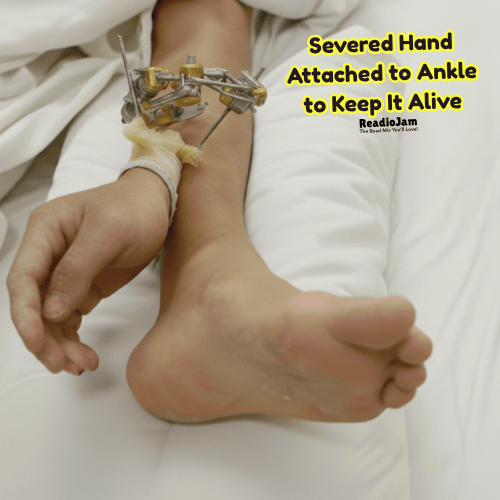
Their solution was daring but rooted in sound medical logic: temporarily attach the hand to Xiao’s left ankle, where strong arteries and veins could nourish it.
They connected the hand’s blood vessels to those in the leg, creating a temporary lifeline.
Within half an hour, blood began circulating through the hand again. For one month, it remained there — stitched gently to the calf — alive and waiting.
The sight was extraordinary: a hand drawing life from a leg, a body keeping part of itself alive through science and ingenuity.
The image seemed almost otherworldly — like something from a futuristic film, much like the surreal creations in Ash, which blends sci-fi horror with hallucinatory mystery in space
The Nine-Hour Restoration
When Xiao’s arm had healed enough, the surgical team prepared for the final stage.
On December 4, 2013, they began a nine-hour microsurgery to return the hand to its rightful place.
Every step was meticulous — reconnecting arteries finer than hair, linking tendons, restoring nerves that carry sensation.
The surgeons’ precision — connecting vessels thinner than hair — felt almost robotic in its accuracy, echoing the remarkable advances in automation like the Optimus Tesla robot that just cooked and cleaned in a real demo.
When the blood returned and the skin warmed, the team knew the operation had worked.
The hand — against all odds — had survived.
Recovery and the Human Will
In the weeks that followed, Xiao began physiotherapy. Each movement was small, hard-earned, and vital.
Dr. Tang reported that the operation had achieved “initial success” but emphasized that further exercises and procedures would be needed to restore agility.
Xiao’s discipline matched the doctors’ skill. He endured the pain of recovery with the same calm resolve that had carried him through the accident.
Two Forces, One Miracle
This story was not built on luck — it was built on presence of mind and medical brilliance.
Had Xiao panicked or delayed, his hand might have been lost forever. His quick thinking preserved precious hours — hours that allowed the doctors to attempt their extraordinary work.
Equally, without the innovation and courage of Dr. Tang and his surgical team, no amount of determination could have saved the hand.
Their creativity — using the ankle graft technique to keep tissue alive — blended science with urgency in a way few had seen before.
Just as archaeologists unearthed a forgotten past in the ancient golden city discovered in Egypt, these doctors uncovered new frontiers of what the human body — and mind — could endure.
Together, patient and doctors turned a devastating injury into a medical milestone.
It was human focus and medical innovation — side by side — that brought life back to a severed hand.