A Hybrid Nobody Saw Coming
A routine wildlife rescue in southern Brazil turned into a groundbreaking discovery when a strange canid, neither fully dog nor fox, was found injured by the roadside near Vacaria, Rio Grande do Sul, in 2021.
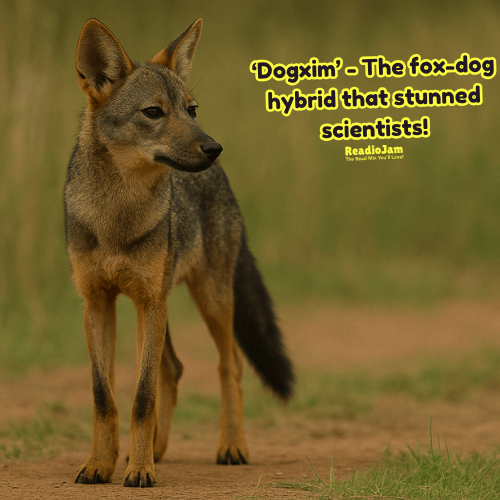
She looked like a Pampas fox but barked like a dog. Her taste for rodents matched her wild instincts, yet she enjoyed playing with dog toys. Dubbed the Dogxim—a blend of “dog” and graxaim (Portuguese for Pampas fox)—this creature became the first scientifically confirmed hybrid between a domestic dog and a Pampas fox.
According to one of the ecologists who cared for her during rehabilitation, Dogxim behaved in ways that placed her behavior squarely between both species—not as tame as a dog, yet not aggressive like a wild fox.
It echoed another stunning biological revelation — a woman whose blood carried her unborn twin’s DNA, a case that baffled doctors and defied scientific understanding.
Cracking the Genetic Mystery
Genetic testing revealed the hybrid’s unique makeup:
- Dogxim had 76 chromosomes, exactly between the dog’s 78 and the Pampas fox’s 74
- Her maternal lineage came from the Pampas fox
- Her nuclear DNA contained genetic material from both species
She inherited:
- A long snout, coarse fur, and slim frame resembling a fox
- But also large ears and dog-like behavior, such as barking and playing with toys
Researchers confirmed this to be the first verified hybridization event between these two species, which are believed to have diverged over six million years ago.
These results rocked the scientific community. Just like NASA’s accidental discovery of Cold War tunnels beneath Greenland’s ice, it was a find no one was looking for, but one that could change everything.




Nature, Interrupted: The Human Factor
Dogxim’s emergence is more than a curiosity—it’s a reflection of increasing human influence on wild habitats.
- Pampas foxes, once restricted to grasslands, now enter urban areas and pastures
- Domestic dogs often roam freely, leading to more opportunities for interbreeding
This interaction brings potential risks:
- Spread of diseases between species
- Disruption of wild population genetics
- Threats to the survival of native species if hybrids reproduce and dominate
Researchers warn that this case illustrates how human development can unintentionally reshape biodiversity.
These shifting ecological boundaries are much like unexpected revelations in archaeology—such as the rediscovery of an ancient Egyptian golden city, long hidden beneath the sands until it suddenly transformed how we understand the past.
Fertility, Risks, and a Short Life
It’s still unknown whether Dogxim was fertile. While many hybrids—like mules—are sterile, some are not. If Dogxim had been capable of reproducing, it could have introduced unpredictable traits into the local gene pool, potentially destabilizing it.
Unfortunately, researchers lost the opportunity to investigate further. Although Dogxim appeared healthy when transferred to a conservation center, she died just months later. No autopsy was performed, and her death remains under investigation.
Some researchers speculate that the hybridization itself may have made her genetically vulnerable, increasing susceptibility to health issues.
It’s a reminder that nature holds the power to surprise—and sometimes overwhelm. Just like a gold zone discovery six times richer than expected shook the mining world, Dogxim forced scientists to re-evaluate what they thought they knew about species boundaries.
Evolution’s Plot Twist
Dogxim’s existence challenges long-held beliefs about species boundaries. Despite a wide evolutionary gap, dogs and foxes were still able to interbreed, revealing that nature’s paths may not be as fixed as once believed.
This rare discovery suggests that hybridization between long-diverged species is still biologically possible under certain environmental pressures.
Rather than seeing evolution as a straight and separate path for each species, some now view it as a dynamic system—more like a web with unexpected intersections.
What else might be waiting to emerge from those intersections? Perhaps the answer lies in the future—much like the 6,000-year time capsule set to open in the year 8113, safeguarding the voices and knowledge of humanity for millennia to come.
What Comes Next
Dogxim’s case offers a cautionary tale and a valuable lesson.
- It underscores the importance of monitoring hybridization in regions where domestic and wild animals overlap
- It serves as a reminder for pet owners to control free-roaming animals near wildlife zones
- It encourages scientists to rethink how species boundaries behave in today’s changing world
Though her life was brief, Dogxim left a significant mark. Her story suggests that more hybrids may exist, unnoticed, and that the consequences of human-wildlife interaction are far deeper than we imagined.