An Interstellar Guest That Keeps on Giving
First spotted on July 1, 2025, Comet 3I/ATLAS has become a global sensation. As only the third interstellar object ever discovered, it has lit a fire under researchers – thanks to surprising behavior that refuses to sit still.
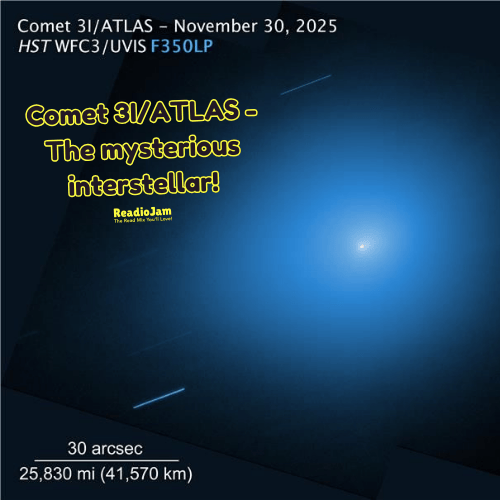
Now, as 2025 winds down, it flips the script again: a strikingly symmetric coma with barely any tail.
“Each new observation provides rare insight into celestial phenomena that are unlike anything found in our own cosmic neighborhood.”
The Journey So Far: Mars Flyby and Solar Close Pass
On October 3, ExoMars TGO and Mars Express viewed 3I/ATLAS at 30 million km, while Hubble and Webb traced its path.
- CaSSIS saw a bright coma, but no clear tail.
- OMEGA, SPICAM, and NOMAD targeted gas/dust signatures.
- Hubble revealed a teardrop-shaped dust cocoon; the nucleus may be 440 m–5.6 km.
- The comet races at 137,000 mph (221,000 km/h) on a hyperbolic escape—no return.
“This was a very challenging observation. The comet is 10,000 to 100,000 times fainter than our usual targets.” — Nick Thomas, CaSSIS PI
For Mars context, see how a serendipitous rover crack changed the life-on-Mars debate.




Juice Sees the Action: First Glimpse of Two Tails
In November 2025, ESA’s Juice caught 3I/ATLAS shortly after perihelion (Oct 29–30) -right as activity ramped up. A Nov 2 quarter-frame NavCam image showed:
- An intense coma
- A plasma tail reaching upward
- A likely dust tail trailing diagonally downward
Closest approach to Juice: 66 million km on Nov 4.
Five instruments—JANUS, MAJIS, UVS, SWI, PEP—collected high-detail data.
Data delivery: Feb 18–20, 2026 (bandwidth constraints).
Scaling cutting-edge sensing isn’t new—see how phone-style silicon is pushing once-impossible quantum computing systems into reality.
December Surprise: A Coma Like No Other
On Dec 3, high-res ground images showed a perfectly round, smooth-gradient coma—no obvious tail. Subtle micro-jets pointed in shifting directions. Long exposures hinted at rotation.
- Coma intensity: ~88%
- Tail visibility: ~22%
- Distance from Earth: ~2.4 AU
- Distance from Sun: ~2.9 AU
- Velocity (heliocentric): ~60 km/s
The symmetry and faint jets defy standard tail models, suggesting unusual particle physics or low dust output—classic interstellar signatures.
Public debates over “what we really saw” feel familiar—just like that viral DiCaprio movie discourse.
Trajectory and Key Numbers
- Perihelion: Oct 29–30, 2025
- Jupiter pass & exit path: March 2026 → outbound forever
- No threat: Closest to Earth ~1.8 AU earlier; now ~2.4 AU
- Origin vector: From Sagittarius
Keeping eyes on a fast mover needs bulletproof remote ops—sometimes even hardware lifelines that revive systems instantly. Like this tiny Wi-Fi device that can reboot a PC from miles away.
Why 3I/ATLAS Matters
This is more than an icy wanderer—it’s a time capsule from another star system, possibly billions of years older than ours.
Compared with ʻOumuamua and 2I/Borisov, Comet 3I/ATLAS shows a hybrid personality: dust jets, symmetric coma, partial tails, and slow evolution.
Expect new chemistry clues and activity physics that challenge the playbook.
Eyes on the Future: Comet Interceptor Awaits
ESA’s Comet Interceptor (launching 2029) will wait in space, ready to sprint toward the next pristine – maybe interstellar – comet.
3I/ATLAS won’t be that target, but it proves why speed and readiness matter.
As global teams trade data in real time, strong cybersecurity is non-negotiable. For a stark reminder, see the $11M bounty case tied to a $18B ransomware trail.