Excerpt
Teen’s AI uncovers 1.5 million hidden cosmic objects from NEOWISE.
Gains $250K prize, Caltech job, and NASA jet-ride offer.
Teen Wins $250K – How it happened?
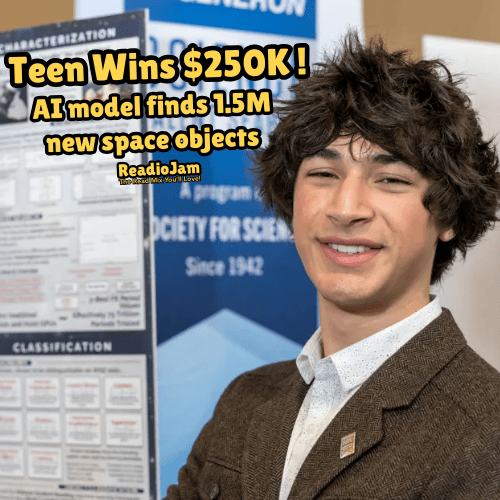
Teen Wins $250K after building an AI that mined NASA’s NEOWISE archive to find 1.5M new space objects.
High schooler Matteo Paz used a custom AI model to scan archived data from NASA’s NEOWISE mission and flagged 1.5 million previously unknown cosmic objects.
This is a huge leap for time-domain astronomy, showing how machine learning can reveal signals humans miss.
“AI can turn old space data into fresh discoveries—fast.”
As sky maps evolve, earthly digs can shock us too: a 3,000-year-old Egyptian city that stunned archaeologists.
From Classroom Curiosity to Caltech Research
Paz’s journey started early at Caltech’s public Stargazing Lectures, then the Planet Finder Academy and a six-week Summer Research Connection. Under mentorship from Davy Kirkpatrick (IPAC, Caltech), he shifted from a small sky patch to tackling the entire dataset.
- Mentors looped in experts Shoubaneh Hemmati, Daniel Masters, Ashish Mahabal, and Matthew Graham.
- Paz studied advanced math through Pasadena Unified’s Math Academy (AP Calculus BC by 8th grade).
After the $250K win, Paz continued at Caltech/IPAC, turning a student project into a sustained research role.


The Data Deluge, Tamed
NASA’s NEOWISE logged ~200 billion infrared detections over a decade—too vast for manual checks. Paz built a Fourier + wavelet–based machine-learning framework tuned to time-series patterns.
- In about six weeks, the system began reliably flagging variable objects: quasars, supernovas, and eclipsing binaries.
- The approach generalizes to other temporal datasets (e.g., atmospheric cycles; even stock time series).
The $250,000 award underscores how ML scales to 200B detections.
Sometimes breakthroughs hide in plain sight—think NASA radar inadvertently exposing a Cold War relic: a secret base rediscovered under Greenland’s ice.
Peer Review, Publication, and a big $250K win
Paz authored a peer-reviewed paper in The Astronomical Journal (titled on extracting variable candidates from the NEOWISE single-exposure database). He then won first place in the 2025 Regeneron Science Talent Search— a $250K science prize that spotlights youth research at national scale.
- The algorithm is shareable: other astronomers can reuse it on similar archives.
- Paz now works at Caltech/IPAC—his first paid job—continuing to refine and catalog results.
Recognition From NASA—and a Fighter Jet Ride
Fresh off the $250K victory, NASA attention followed. NASA director Jared Isaacman publicly invited Paz to apply and added an unusual perk.
Jared Isaacman: “Matteo please apply to work at NASA and I will personally throw in a fighter jet ride as a signing bonus.”
Pointing Big Telescopes to New Targets
Coordinates from Paz’s catalog are being used to guide observations for the James Webb Space Telescope (JWST) and to expand the scientific reach of NEOWISE’s legacy data.
- Faster triage of transients means quicker follow-ups.
- Long-term variability baselines sharpen models of galaxies, black holes, and exploding stars.
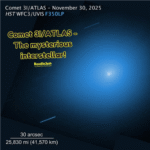
If transient hunts thrill you, you’ll love this: the once-in-a-lifetime mystery of Comet 3I/ATLAS.
The Human Side: Mentorship and Momentum
Kirkpatrick’s mentorship was pivotal. Paz credits the freedom to aim big from day one.
Matteo Paz: “I said I was considering working on a paper… He didn’t discourage me. He said, ‘OK, so let’s talk about that.’”
Davy Kirkpatrick: “If I see their potential, I want to make sure that they are reaching it.”
Beyond Space: Broader AI Uses
Because the AI model excels with time-series, it can transfer to other domains where periodicity and bursts matter—environmental pollution cycles, and possibly financial pattern analysis.
- Same tools, different signals.
- The key is structure and scale.
Pattern-spotting reshapes media too—see how a headline-grabbing Netflix release sparked debate: a DiCaprio film 171M people watched—but did they really see it?
What’s after this $250k award?
- Post-$250K victory, the full catalog of 1.5M variables to be released for community use.
- Continued Caltech/IPAC development and student mentorship.
- More follow-ups with JWST and other observatories.