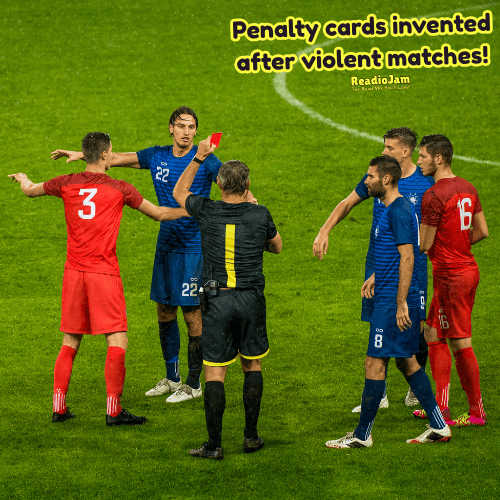
The Day Football Became a Battlefield
It was June 2, 1962, in the dry heat of Santiago, Chile. The air smelled of sweat, dust, and hostility. The World Cup match between Chile and Italy had begun like any other — but it would end as one of the most violent games in history.
The tension had been brewing for days. Chilean newspapers accused Italian journalists of insulting their women — calling them “ill-mannered and of low beauty.” By kickoff, fury filled the stands like smoke.
Referee Ken Aston, a calm Englishman with a schoolteacher’s patience, walked out onto the field in his black uniform. He didn’t yet know he was about to referee what journalists would later call “The Battle of Santiago.”
Within minutes, boots flew higher than the ball. A Chilean player’s nose broke. An Italian retaliated with a punch. The crowd roared — not in delight, but in bloodlust. Fists replaced footballs. At one point, armed police stormed onto the pitch to pull players apart.
“I wasn’t refereeing a football match,” Aston said years later. “I was acting as an umpire in military manoeuvres.”
He sent off two Italian players. The match limped to an end with Chile winning 2–0, but Aston walked off drenched not just in sweat — but disbelief.
How could a game that unites nations descend into such madness simply because people couldn’t understand each other?
Moments like these reveal how quickly human behavior spirals when tension builds — on the pitch or in real life. If recognizing these signals fascinates you, here’s a useful read on 15 friendship red flags that help you spot fake friends fast.
The Wembley Confusion
Four years later, the same problem returned — this time on home soil.
Wembley Stadium, 1966 World Cup, quarter-final: England vs Argentina.
Referee Rudolf Kreitlein from Germany sent off Antonio Rattín, Argentina’s fiery captain. But Rattín, who didn’t speak German or English, stood his ground, shouting and waving. The referee shouted back. Nobody understood anyone. The fans booed, the players argued, and chaos crept back onto the pitch.
Rattín refused to leave until police escorted him away.
England’s manager, Alf Ramsey, later had to ask FIFA officials if his players had been booked — even they weren’t sure.
To millions watching, football looked like a sport that couldn’t speak its own language.



A Stoplight Moment
That night, Ken Aston — now part of FIFA’s Referees’ Committee — drove home through Kensington High Street in London. His mind was a blur of shouting players and confused gestures. The city lights flickered on the rain-streaked windshield.
Then, a red glow flooded his car. The traffic light changed — red, then yellow.
He stopped. And in that pause came the spark.
“Yellow — take it easy. Red — stop. You’re off.”
In that instant, football found its missing words.
When he reached home, his wife Hilda cut two cards from colored paper — one red, one yellow. Simple, silent, and universal. The next day, Aston took them to FIFA. The idea was approved, and the language of football was born — not in a stadium, but at a traffic stop.
It’s fascinating how everyday moments can reshape history — much like how a 6,000-year-old time capsule quietly waits to be opened in 8113 AD, hiding secrets we can only imagine
1970: The First Flash of Color
At the 1970 World Cup in Mexico, referees reached into their pockets for the first time — not for a whistle, but for a card.
The yellow warned: you’re close to the line.
The red declared: you’ve crossed it.
Under the blazing Mexican sun, those colors glowed like justice itself. The cards became the referee’s shield against chaos.
Yet ironically, not a single player saw red that year. It wasn’t until 1974, in West Germany, that Chilean forward Carlos Caszely received football’s first-ever visual red card — a poetic twist, as it was his own nation where the storm had begun.
When England Turned Away
In a strange twist, England — Ken Aston’s homeland — decided in 1981 to ban the cards. The FA claimed the colors might provoke angry fans. For six confused years, referees went back to shouting and gesturing — and, predictably, back to chaos.
By 1987, football’s global governing body stepped in. The International Football Association Board ordered England to reinstate the cards. Order was restored; color had won.
Ken Aston’s Final Whistle
Aston continued teaching long after retiring from the pitch. He trained referees worldwide, ran workshops in the U.S., and reminded them that the job was more art than authority.
“The game should be a two-act play,” he said, “with 22 players on stage and the referee as director.”
That philosophy wasn’t just about football — it was about performing under pressure. Aston believed that whenever the spotlight hits you, whether you’re on a pitch or in a boardroom, clarity and confidence become your greatest tools. And if you’ve ever faced a high-stakes moment yourself, you’ll appreciate these 9 hidden job-interview hacks that help you stay composed when it matters most
He received the MBE in 1997, a nod to the man who made fairness visible.
When he passed away in October 2001, aged 86, the world mourned not just a referee, but a storyteller — one who turned chaos into clarity with nothing more than two colors and a teacher’s heart.
Aston’s legacy endures the same way great monuments do — quietly, powerfully, unmistakably. The feeling is similar to standing before Milan’s Castello Sforzesco, a fortress that has survived centuries of conflict and still stands as a testament to art, power, and resilience.
The Colors That Tell a Story
Every flash of color since then has carried Aston’s legacy.
- Zinedine Zidane’s headbutt, Berlin 2006.
- Luis Suárez’s handball, South Africa 2010.
- Singapore’s triple red heartbreak, Suzuki Cup 2020.
Every one of those moments began the same way — with a simple lift of the referee’s hand, a card glinting under the lights, and millions holding their breath.
From Santiago’s dust to Wembley’s green, from chaos to order — Ken Aston gave football not just color, but clarity.
He gave it a voice.