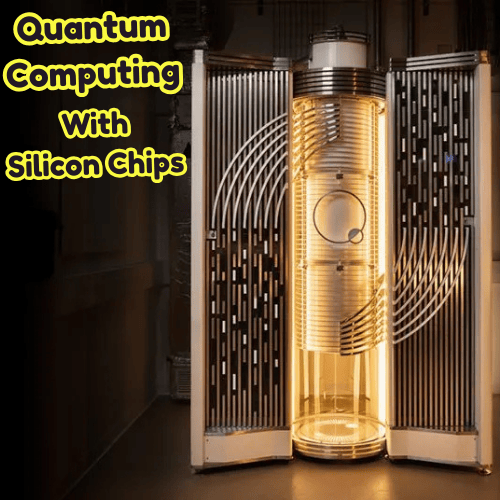
Quantum Computing Built Like a Smartphone
Quantum computing just took a bold leap forward.
UK-based startup Quantum Motion has built the world’s first full-stack quantum computer using standard silicon CMOS technology — the same process that powers smartphones, laptops, and other digital devices.
Now fully operational at the UK’s National Quantum Computing Centre (NQCC), this achievement marks a major turning point. For the first time, quantum computing hardware runs on technology proven to scale in the real world.
“This is quantum computing’s silicon moment,” said James Palles‑Dimmock, CEO of Quantum Motion.
“You can build a robust, functional quantum computer using the world’s most scalable technology.”
Quantum Hardware That Fits in a Rack
This new quantum system is designed for practical deployment:
- Fits inside just three standard 19” server racks
- Contains a dilution refrigerator and control electronics
- Works in traditional data center setups
- Supports plug-and-play QPU upgrades
At its core, the quantum computing unit uses a tile-based QPU architecture. Each tile includes compute, readout, and control — making it easy to scale across chips and expand to millions of qubits.
In the future, we may see AI models trained on quantum systems running directly on edge hardware, similar to what’s being explored in AI-powered mini PCs.




A Full-Stack Quantum Platform, Optimized by AI
Unlike earlier prototypes, this is a complete quantum computing platform.
Quantum Motion engineered it to support:
- Industry frameworks like Qiskit and Cirq
- A developer-ready interface
- AI-enhanced machine learning tuning for calibration and optimization
With these capabilities, the platform accelerates setup and reduces the overhead of maintaining a complex quantum machine.
“It’s a customer, user, and developer-first approach,” said Hugo Saleh, President and CCO.
“We’re using standard CMOS — the foundation of mobile phones and AI GPUs — to deliver the next computing revolution.”
As AI systems become more advanced and autonomous, their behavior will increasingly rely on core infrastructure like this. But understanding their limitations is equally vital — especially as issues like AI hallucinations become more common across industries.
Quantum Computing at the UK’s National Centre
The machine is now part of the NQCC’s Quantum Computing Testbed Programme. This initiative supports the development and validation of multiple quantum computing technologies.
According to Dr. Michael Cuthbert, Director of the NQCC, the installation represents a significant milestone. He shared that the team is “really excited to start test and validation of the system and better understand how real-world applications will map onto its silicon architecture.”
The NQCC aims to transform industries through applied quantum computing, including:
- Healthcare (such as drug discovery)
- Energy (grid efficiency)
- Material science and AI research
And while breakthroughs in hardware get much of the attention, the future of AI also hinges on how companies handle ethical concerns — a challenge being tackled by visionaries like Datumo, which raised $15.5M to build AI systems with safety at their core.
Quantum Systems Backed by World-Class Research
This machine isn’t an isolated achievement — it builds on years of academic progress.
Quantum Motion partnered with University College London (UCL), producing qubits in natural silicon on 300mm wafers. Their earlier research reached:
- 98% two-qubit gate fidelity
- Fabrication on industry-compatible chips
In addition, Quantum Motion contributes to:
- SiQEC, a UK-led silicon quantum error correction program
- DARPA’s QBI, a US initiative for scalable quantum computing systems
These partnerships advance fault tolerance — one of quantum computing’s biggest technical challenges.
A Shift from Specialized to Standard Hardware
Historically, most quantum computing platforms used highly specialized or fragile materials. While innovative, these setups were difficult to scale and expensive to manufacture.
Quantum Motion’s use of mass-producible silicon changes the game. As a result, the system benefits from:
- Lower cost of production
- Familiar supply chains
- Faster, more efficient scaling
This opens up possibilities across domains, including sectors like AI in real estate, where predictive models and data processing could soon tap into quantum-level acceleration.
Quantum Computing’s Path to Commercial Reality
According to Hugo Saleh, the company is on track to launch commercially viable quantum computing machines before 2030. Their strategy is grounded in real-world components, developer ecosystems, and scalable architecture.
UK Science Minister Lord Vallance praised the NQCC for enabling this kind of breakthrough. He highlighted its potential to accelerate innovation in fields like clean energy, medicine, and AI development.
Quantum computing is no longer limited to theory or research labs. It’s becoming practical, powerful — and portable.