The Discovery That Stunned Medicine
It began like the opening scene of a medical thriller.
A doctor squinted at a lab report, his hand trembling slightly. The result in front of him was impossible.
Ana Paula Martins, a 34-year-old woman from Brazil, had male chromosomes—XY—in her blood.
Yet the patient standing before him was unmistakably female. She had a uterus, ovaries, and every biological marker of womanhood.
“I examined the patient… she had a uterus, ovaries, all normal female features,”
said Dr. Gustavo Maciel, gynecologist and professor at São Paulo University.
At first, everyone in the room thought it must be a mix-up, a contaminated sample, a computer glitch.
But the second test said the same thing.
And so did the third.
“Her blood says male. Her body says female.”
A chill ran through the room.
What had started as a simple checkup after a miscarriage had just cracked open one of the most extraordinary genetic mysteries in modern medicine.
The Flashback: A Miscarriage That Changed Everything
Just months earlier, in 2022, Ana Paula had endured a heartbreaking miscarriage.
Her gynecologist recommended a routine karyotype test, a standard chromosome check used after pregnancy loss—to rule out genetic issues.
It was supposed to bring closure, maybe an explanation.
Instead, it opened a door to a discovery so rare, it would rewrite what scientists believed about human biology.
What was meant to explain why she lost a child ended up revealing why she carried two sets of DNA.
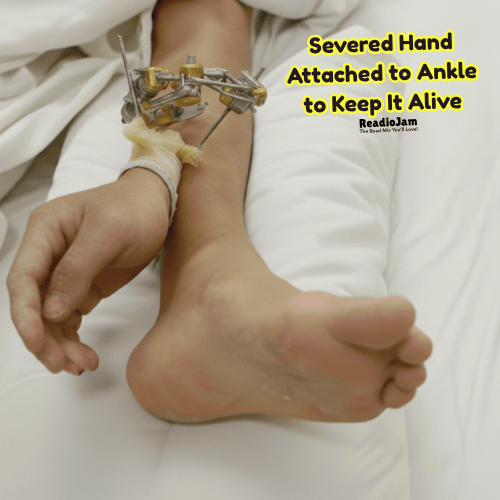
Stories like Ana Paula’s remind us how far modern medicine can stretch the boundaries of life itself — much like the astonishing case where a severed hand was temporarily attached to a leg just to keep it alive.



When Two Lives Become One: The Chimerism Revelation
The final diagnosis stunned geneticists around the world.
Ana Paula’s condition was identified as spontaneous chimerism—a biological phenomenon where two sets of DNA coexist within one body.
Chimerism can occur after medical treatments like bone marrow transplants, but Ana Paula’s case was naturally formed, making it the first of its kind ever recorded in humans.
Her skin, mouth, and reproductive cells carried XX chromosomes—her own.
But her blood? It was XY, genetically identical to a twin brother who never lived to be born.
“In her blood, she is, in fact, her brother,” said Dr. Maciel.
“A piece of her brother circulates inside her,” added Dr. Caio Quaio, geneticist at Albert Einstein Israel Hospital.
The Womb-Level DNA Swap
To understand the mystery, doctors looked back to where all stories begin—the womb.
During her mother’s pregnancy, Ana Paula and her twin brother’s blood vessels likely fused, a rare event known as fetal-fetal transfusion syndrome.
Through that microscopic bridge, her brother’s blood-forming stem cells migrated into her bone marrow, silently taking root.
“The blood vessels in the umbilical cord got tangled… and all the blood passed to Ana Paula,”
explained Dr. Maciel.
From that moment, Ana Paula’s body would produce male DNA blood for the rest of her life—without altering her female anatomy, hormones, or fertility.
A Miracle Pregnancy Amid Mystery
Years later, despite the XY blood flowing through her veins, Ana Paula’s female reproductive system worked flawlessly.
During genetic research into her case, she conceived again—and this time, gave birth to a healthy baby boy.
Genetic testing confirmed:
- Half of the baby’s chromosomes came from Ana Paula
- Half came from the father
- None came from her twin brother
“My egg cell had my DNA. The blood wasn’t involved,” clarified Prof. Maciel.
For Ana Paula, the truth brought more relief than fear.
“It wasn’t something that could get in the way of achieving my goal of having my baby,” she said softly.
While Ana Paula’s story celebrates connection at a cellular level, not every bond in life brings healing. Some relationships can drain us instead of making us stronger. Learn how to spot fake friends fast.
A Scientific Breakthrough in Immunology
What fascinated scientists most wasn’t just the DNA swap—it was how her body lived with it peacefully.
Normally, a body would attack and reject foreign DNA. But Ana Paula’s immune system had learned to accept her brother’s XY cells as its own.
That rare immune tolerance could pave the way for revolutionary advances in:
- Organ transplantation, reducing rejection rates
- Mixed chimerism therapies, already tested in islet transplantation
- Immune research, to understand how the body can live in harmony with foreign cells
“Her body accepted the XY cells without needing any immunosuppressants. That’s phenomenal,” reported several immunology studies.
Sometimes, survival means letting go—of what hurts, of what no longer belongs. Just as Ana Paula’s body learned to coexist with foreign DNA, we too must learn when to make peace or move on. Here’s a guilt-free guide to letting go of toxic friendships.
A Story That Captivated the World
Ana Paula’s story soon went viral, shared by Dr. Harini Bhatt in a now-famous reel calling it a “miracle of biology.”
What began as a painful loss became a celebration of the body’s resilience, mystery, and quiet miracles.
“The human body is truly amazing,” said Dr. Bhatt.
Ana Paula’s case also challenges how we view gender and biology—reminding us that even long-held beliefs can evolve. Discover why “ladies first” began as a survival tactic, not romance.
And while medicine is rewriting the rules of biology, technology is doing the same for innovation. Here’s how Microsoft’s AI-powered Excel is changing the game—beyond just numbers.
Ana Paula Martins isn’t just the woman with two DNAs—she’s living proof that even within tragedy, science can uncover beauty. And sometimes, the deepest connections —like that between a girl and her lost twin — can live forever, cell by cell.