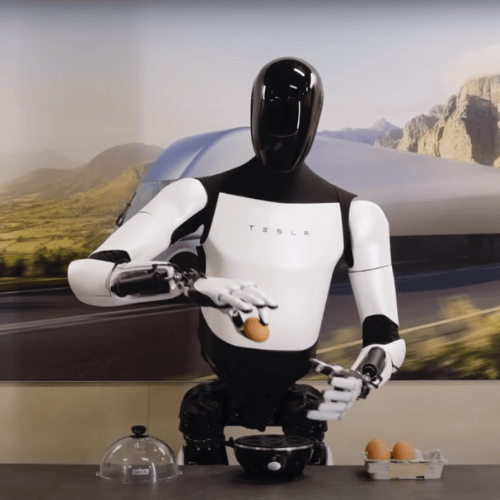
The Optimus Tesla Robot Cooks, Cleans, and Surprises Everyone
In a real, public demo, Tesla’s Optimus Gen 3 robot was shown performing household tasks—cooking and cleaning included. It stirred, grabbed, wiped, and interacted with objects naturally, powered by Tesla’s in-house AI.
This surprising showcase didn’t just go viral – it made people wonder:
“Could this be the start of robots in everyday homes?”
And while the demo sparked headlines, Tesla’s long-term vision for Optimus goes even deeper.
Why the Optimus Tesla Robot Is Central to Elon Musk’s Vision
According to Musk:
“~80% of Tesla’s future value will come from Optimus.”
That’s not a side project—it’s the future of Tesla.
From “Tesla Bot” in 2021 to the latest Optimus Tesla robot, Musk has made it clear: this isn’t about creating a robot for fun. It’s about building the physical version of AI—an assistant that could one day be as common as a smartphone or an electric car.


How the Tesla Humanoid Robot Has Evolved
From its early days as a stage concept in 2021, the Optimus Tesla robot has made impressive strides. After unveiling the first working prototype in 2022, Tesla released Gen 2 in 2023 and has now introduced Gen 3 in 2025.
So, what’s new in this version?
- A natural heel-to-toe walking gait
- 22 degrees of freedom in its hands, allowing for fine motor tasks
- A unified AI brain powered by Tesla’s Grok model
- Training that relies on video footage of humans, rather than motion-capture suits
Because of this, the Optimus Tesla robot can now learn skills just by watching humans do them—making it easier for Tesla to scale new behaviors.
As Tesla trains Optimus using this architecture, it reflects a broader shift in computing innovation—especially as technologies like quantum computing in smartphones start to reshape AI training itself.
What It Can Do (And What It Can’t Yet)
So far, Tesla has shown Optimus performing a wide range of tasks:
- Cooking and cleaning in a real, recorded demo
- Opening and closing cabinets
- Tearing paper towels and taking out the trash
- Serving drinks and interacting with people at Tesla events
- Handling car parts inside Tesla’s factories
Clearly, these are not minor feats—especially for a general-purpose humanoid. However, it’s important to point out that most of these tasks happen in controlled or lightly staged environments, where lighting and object placement are predictable.
The Salesforce Demo Sparked More Questions Than Answers
Not all reactions have been glowing.
In a demo at Marc Benioff’s office in early September 2025, the Optimus Tesla robot performed basic tasks like walking and object handling. Yet, observers noted its slow, cautious movements and awkward response time.
“The robot didn’t feel autonomous—it felt teleoperated or scripted,” said one analyst.
Tesla later clarified that the slow motion was intentional, to prioritize safety. Still, the demo created skepticism among investors and analysts. It reminded everyone that while Tesla’s robot looks impressive, it still has a long way to go in terms of reliability and real-world autonomy.
This reminds us just how vulnerable even the most innovative tech can be—especially in a world where cyber threats are escalating. Take, for example, the shocking story of a hacker who stole $18 billion from 250 companies.
Can Tesla Actually Mass-Produce the Optimus Robot?
Musk has claimed that Tesla will:
- Produce 5,000 Optimus robots by the end of 2025
- Scale up to 1 million units per year by 2029
However, production is reportedly still in the low hundreds, far from the announced goals.
Additionally, a major roadblock emerged in 2025: China’s export restrictions on rare-earth materials, which Tesla uses in the robot’s actuators. Though Tesla is working on alternative sourcing, the episode revealed how global supply chain volatility could seriously delay progress.
“Without the right parts, even the smartest robot can’t be built.”
Moreover, Musk’s promised $20,000–$30,000 price point remains speculative until Tesla can show evidence of consistent cost reduction and serviceability.
Where Tesla’s Robot Stands in a Crowded Race
Tesla isn’t alone in building humanoids. In fact, it’s part of a fast-growing global race.
Mobility & Movement
- Boston Dynamics’ Atlas still leads in agility, showcasing jumps, flips, and recovery skills.
- In contrast, the Optimus Tesla robot prioritizes steady motion and energy efficiency—ideal for industrial and domestic roles.
Commercial Use Cases
- Agility Robotics’ Digit is already in paid logistics deployments.
- Figure and Apptronik are pushing into manufacturing environments.
- Tesla’s Optimus, by comparison, is still largely in-house, operating only in Tesla facilities.
China’s Focus
Meanwhile, Chinese firms like UBTECH and Unitree are refining purpose-built industrial robots. These robots are not human-like but are engineered for affordability, uptime, and factory deployment—a sharp contrast to Tesla’s humanoid-first approach.
Meanwhile, other industries are also being transformed by AI in quieter, behind-the-scenes ways—just look at how AI is changing the real estate market.
So, Is the Optimus Tesla Robot Ready for Your Home?
For now, the Optimus Tesla robot is closer than it’s ever been – but still not quite ready for mass adoption.
“It’s a remarkable leap forward, but not the finish line.”
The robot’s ability to cook and clean is a milestone. Still, real-world autonomy, customer readiness, and cost-effective service must catch up before it becomes your next kitchen companion. What Tesla has shown is a proof of concept – a signpost on the way to a future where AI-powered robots could assist in homes, offices, and beyond.