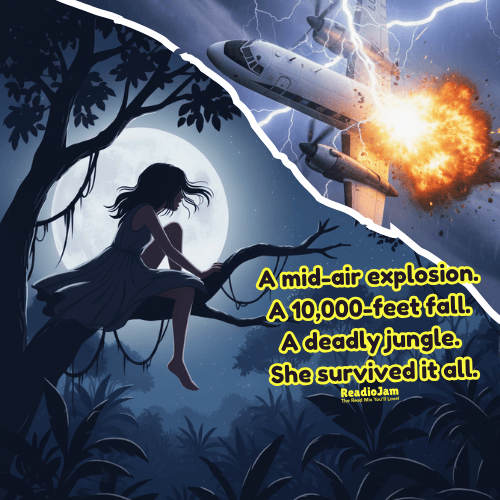
The girl who fell from the sky
When Juliane opened her eyes, the scene around her made no sense. Leaves swayed above and below her, as if the forest had flipped upside down. A humid wave of wet soil, crushed foliage, and rotting fruit washed over her.
Bird calls cut sharply through the air.
Heat pressed against her skin.
Insects darted across scattered beams of light.
Her vision steadied enough to recognize she was hanging inside a massive tree, her airplane seat jammed into the branches, seatbelt still locked around her. Thick vines curled around the metal frame as though nature itself had grabbed it.
Pain radiated through her. The collarbone felt unstable. Cuts stung along her arms and legs. Her head throbbed from a concussion. Without her glasses, the world blurred into distorted shapes. Her thin summer dress clung to her, soaked and torn.
She didn’t understand how she had landed there. She only understood the most important thing: she had survived the unthinkable.
“I didn’t know if I was alive or dead.”
Beneath her, the forest floor formed a dark maze. Above her, the sky peeked through like a witness to the impossible. Her situation felt so unreal it reminded her of discoveries that stunned the world—like the time NASA accidentally uncovered a hidden city buried under ancient ice.
When the sky turned violent
Hours earlier—December 24, 1971—Juliane and her mother boarded LANSA Flight 508, preparing to spend Christmas with her father.
Mid-flight, everything changed.
Storm clouds rose like mountains. Lightning cracked across the windows. The aircraft rattled with escalating turbulence.
A blinding flash lit the cabin.
The fuselage twisted.
A deafening crack tore through the plane.
The aircraft broke apart in mid-air. In that chaos:
Juliane, still buckled into her row of seats, plummeted 10,000 feet—unconscious, falling through clouds, debris, and violent wind.
Her next memory was waking in the tree.



A girl, alone against the Amazon
Once she climbed down, the forest overwhelmed her senses. The air carried the heavy smell of sap, mud, river minerals, and decomposing vegetation. The humidity clung to her skin.
Every movement hurt. Her collarbone shifted painfully. Cuts throbbed with heat. Her head felt foggy and slow. Without her glasses, she could barely distinguish where to step. Her dress, torn and soaked, stuck uncomfortably to her.
But she heard something steady in the chaos: the soft flow of running water.
Her father’s voice echoed clearly in her memory:
“If you’re ever lost, follow water. Water leads to people.”
It was a simple instruction—almost meditative. The kind of grounding clarity that echoes the surprising idea that taking just 10 minutes to do nothing can actually make you smarter.
She followed the sound.
Eleven days inside a living jungle
The Amazon looked and sounded alive. Light broke through the canopy in golden shafts. Vibrant insects flickered like sparks. Animal calls echoed from every direction.
But danger followed her.
Nightfall brought instant darkness. The sounds intensified—monkeys shrieking, insects buzzing like wires, creatures moving in water she couldn’t see into.
She followed streams, stepping through water where unseen plants and animals brushed against her. Her wounds worsened. Infections grew. Maggots appeared in the deeper cuts. Hunger became constant and sharp.
Her wounds worsened. Infection set in. Maggots formed deep inside the cuts. Hunger gnawed at her relentlessly. Yet she stayed steady, following the stream one slow step at a time. That level of composure — staying centered while everything around you spirals — is the same mindset behind learning how to shut down workplace drama with one powerful habit.
The creek became her guide.
The hut that saved her life
By the 11th day, she could barely stay upright. Through the trees, she saw a weathered wooden hut, leaning slightly to one side.
Inside, the harsh smell of gasoline hit her. It was completely foreign compared to the earthy jungle scents, but she recognized its purpose. Her father had taught her that gasoline could kill maggots in wounds.
Holding onto the wall, she poured it over her injuries. Pain surged so intensely she had to steady herself to stay conscious.
The next morning, she heard paddles moving through the river. Three local fishermen guided a wooden boat along the water. When they saw her—thin, sunburned, trembling—they reacted instantly. One handed her water, another examined her wounds, and the third helped her into the boat with steady hands.
They took her to safety.
Hours later, she saw her father again—who had been told there were no survivors.
Her survival felt impossible—much like the woman whose blood test revealed two different DNAs, leaving experts stunned by what the human body can hide.
She was the exception.
The life after the fall
Juliane’s story captured international attention. Experts analyzed how she survived a fall no one should survive. She never claimed it was luck.
“What saved me wasn’t just luck—it was knowledge and willpower.”
She became a biologist, dedicating her life to the rainforest—the place that nearly ended her life, but also gave her the strength to fight through it.Her memoir, When I Fell From the Sky, remains one of the most compelling survival stories ever told.