A Battlefield of Absence
Christopher Nolan’s ‘The Odyssey’ trailer opens on a striking image of absence. A deserted battlefield stretches across the frame, marked by crude gravestones for fallen soldiers. Each helmet bears a red fur crest, clearly identifying them as men from Ithaca—Odysseus’ army.
The light is warm but fading, like a sun on the edge of collapse. As a result, the image feels less like victory and more like aftermath. When the camera settles on a freshly slain soldier’s grave and Odysseus stands before it in silence, the film signals what this journey will cost.
War empties the frame before it fills the story — a truth we’ve traced before in etiquette’s darker origins (read why ‘Ladies First’ began with fear, not love).
Salute, Not Surrender
Soon after, in Nolan’s Odyssey trailer, Odysseus kneels before a black-armored warrior who appears to be Agamemnon, the King of Mycenae. The setting resembles the Trojan coast just after the Greeks’ victory. At first glance, the gesture reads surrender—which is exactly how I initially read it. But once you revisit the story, the meaning changes. This is not defeat but respect—a salute to a superior king.
Still, Nolan doesn’t frame the moment simply. The helmet’s uncanny resemblance to The Batman adds a modern echo, raising a quiet question: is this merely military protocol, or is Nolan hinting at something larger about power, hierarchy, and submission?
The line that summarizes ‘The Odyssey’
“After years of war, no one can stand between my men, and home, not even me”, says Odysseus.
And these three scenes aptly summarize the line – whole and undiluted, as its living proof.
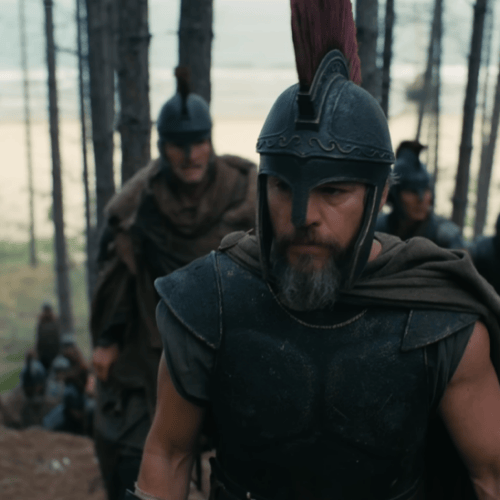
Odysseus leads his soldiers through a dense forest. Matt Damon’s expression is severe, stripped of heroics. The men look exhausted, weathered by years of fighting. Importantly, the shot refuses to romanticize the march.
It suggests that survival itself has grown uncertain, and that this homeward leg may cost more lives than the war ever did. The line becomes a burden he chooses to carry, not a boast.
If the march feels like a tax on bone and tendon, these simple at-home moves show how to keep joints from paying the price.
Cut to Ithaca. The palace sits high on a mountain, its flag fluttering in the wind. From a terrace-like vantage, the trailer shows, his wife Penelope (Anne Hathaway) and son Telemachus (Tom Holland) wait. The son looks restless and unsure, as though hope has thinned to a thread. In contrast, Penelope holds grief and belief in the same breath. Even in despair, she expects Odysseus to return.
The moment turns waiting into a study of time: how it erodes certainty differently for each person.
Back to the sea. Odysseus and his men row a small wooden ship through rough waters. The scene glows with oil lamps—no visible artificial light. The darkness feels authentic and deeply unsettling; silence gathers before the storm. The vessel looks handcrafted and historically grounded, as if Nolan built it for real. It’s a handmade realism the Odyssey trailer leans on – the oars cutting water in perfect rhythm, a fleeting harmony before chaos returns.
Together, these parallel images—forest, home, and sea—perfectly reflect Odysseus’ vow: nothing stands between his men and home but the peril they accept.
Raising the Horse: Sun-Blasted Myth
The trailer shifts to the beach at Troy, where Greek soldiers struggle to raise the massive Trojan Horse. The sun beats down hard, and the scale feels overwhelming. Rumors whisper that Nolan built a full-sized wooden horse. Judging by the weight and texture on screen, it’s believable.
Monuments move because hands do; we felt a different kind of spectacle when 171 million people hit play and the real debate began.
Inside the Horse, tension spikes. Odysseus and his men crouch in near darkness, lit only by lamps. Suddenly a sword slices down from above, injuring one of their own. The moment lands because it punctures the idea of a flawless plan. Even ingenuity, Nolan reminds us, carries unpredictable consequences.
The Cyclops: Practical Nightmares
One of the trailer’s most practical nightmares arrives, in a cave where firelight flickers across stone. Odysseus turns and faces Polyphemus, the one-eyed Cyclops. Given Nolan’s long-standing aversion to heavy CGI, the creature reads like animatronics—and it looks disturbingly real. In the next beat, the soldiers flee downhill in daylight. Did Odysseus wound the Cyclops? Did he kill it? The trailer withholds, trusting curiosity.
Crossing the Dead: The Underworld’s Counsel
The men enter a mist-covered, haunted landscape—the Underworld. According to myth, Odysseus must perform a ritual here to find his way home. The dead rise, and Odysseus’ face holds fear, confusion, and fragile hope at once.
The scene feels relatable: it mirrors the human habit of making choices we’re uncertain about simply because doing nothing is worse.
Storm Logic: Wrath or Error
Chaos returns at sea. A violent thunderstorm hurls men across the deck, the ship rocks like a pendulum, and Odysseus fights to hold everything together while urging his crew on.
Is it Zeus’ punishment? Or the human mistake of opening the Bag of Winds? Nolan keeps the mystery intact.
When sky and sea turn volatile, memory leans on other strange nights we watched the heavens misbehave—like Comet 3I/ATLAS in real time.
The Face You Misread
In the final moments of ‘The Odyssey’ trailer, a woman cups Odysseus’ face and asks, “Promise me, you will come back.”
He answers, “What if I cant.”
It plays intimate, almost romantic. Yet the profile isn’t Penelope. This strongly suggests Calypso (quite likely played by Lupita Nyong’o), the immortal nymph who detains him with the lure of comfort and forever.
Or possibly Circe, the sorceress (possibly played by Charlize Theron). The trailer declines to confirm, letting uncertainty linger. It’s a smart and effective tease.
Score and Image: Rhythm of Dread and Hope
Ludwig Göransson’s score tightens steadily—tension, mystery, perseverance, grandeur—while Hoyte van Hoytema’s cinematography alternates between warm sun and cold darkness.
Together, they produce a visual-emotional rhythm that feels unmistakably Nolan.
Early Reactions and the Darker YouTube Look
Early audience response is glowing, with many hoping for a three-hour runtime to honor the epic’s complexity. Some viewers note the trailer looks too dark on YouTube. I agree; switching to 4K and raising brightness helps.
Theatergoers who saw the extended prologue report a different, more luminous experience—suggesting a platform issue, not an artistic flaw.
What Shape Will the Myth Take?
Will Nolan prioritize raw emotion over spectacle? How far will he lean into fantasy? And how will he wield time, his favorite device? If Interstellar proved he can blend science, emotion, and scale, The Odyssey may show how myth can be grounded in human struggle.
If Nolan aims for raw emotion over spectacle, note how another blue-planet epic is chasing bigger, darker, and sadder—Avatar: Fire and Ash.
We won’t know until July 2026. Until then, The Odyssey Trailer does what great trailers should: ignite curiosity and refuse easy answers.