Turning Trash Into a Building Treasure
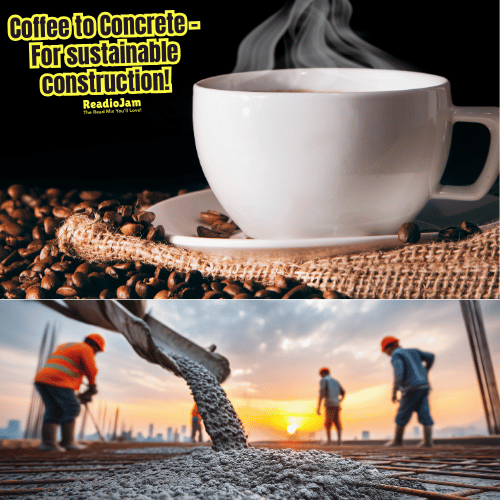
Think coffee to concrete – engineers at RMIT University in Australia have discovered that used coffee grounds—usually headed for landfills—can dramatically enhance concrete strength by up to 30%.
Through a special low-energy process known as pyrolysis, these grounds are converted into biochar, a carbon-rich material that strengthens cement and can replace a portion of natural sand, a resource in crisis.
This innovation tackles two global problems at once:
- More than 11 million tons (22 billion pounds) of coffee waste ends up in landfills each year, releasing harmful greenhouse gases.
- The construction industry uses around 50 billion tons of sand annually, often mined from environmentally fragile riverbeds.
“The ongoing extraction of natural sand to meet the rapidly growing demands of the construction industry has a big impact on the environment.”
– Professor Jie Li, RMIT University
How It Works: From Coffee to Concrete
Coffee to concrete doesn’t mean raw grounds; they can’t be added directly – they contain organic compounds that weaken the material.
Instead, the team heated the grounds to over 350°C (660°F) in a low-oxygen environment. This process – pyrolysis – breaks the waste down into porous, durable coffee biochar concrete that bonds tightly with the cement matrix.
Managing those lab results gets easier when spreadsheets get smarter—see how Excel’s new Copilot can summarize and tag data inside cells (with caveats for high-stakes math).
“The disposal of organic waste poses an environmental challenge as it emits large amounts of greenhouse gases, including methane and carbon dioxide, which contribute to climate change.”
– Rajeev Roychand, Lead Author and RMIT Engineer
Interestingly, when the coffee was pyrolyzed at 500°C, the resulting particles were less effective—proving lower energy use not only works, but works better.




What Makes This Discovery So Powerful
RMIT’s research doesn’t stop at coffee. Their team has already developed optimized biochars from:
- Wood waste
- Food scraps
- Agricultural residues
- Municipal solid waste
This adds new value to what would otherwise rot in landfills.
“Our team has gained extensive experience in creating biochars from different waste streams for concrete applications.”
– Dr. Mohammad Saberian, RMIT Researcher
As the team proves biochars from diverse waste streams, another field shows similar pragmatism: quantum computing on standard silicon.
Researchers are benchmarking & testing this coffee to concrete mix under real-world stressors:
- Freeze/thaw cycles
- Water absorption
- Abrasion and erosion
- Long-term structural durability
Even field tests benefit from portable horsepower—see a compact rig like
this AI mini PC that punches above its size for on-site analysis.
Governments Are Paying Attention
The study, published in the Journal of Cleaner Production, is already influencing public infrastructure planning. Several local governments are exploring the integration of coffee biochar concrete into upcoming projects.
“They have already engaged us for their upcoming infrastructure projects incorporating pyrolyzed forms of different organic wastes.”
– Rajeev Roychand
This approach ties in with a broader circular economy vision—reusing waste to preserve finite natural resources.
“From an Indigenous perspective, my research is about Caring for Country—ensuring a sustainable life cycle for all materials.”
– Shannon Kilmartin-Lynch, RMIT Engineer
As agencies digitize specs and audits, hardware matters too—
an Intel 18A-era AI PC chip made in the U.S. shows where efficient, secure local compute is headed
Why It Matters More Than You Think
Here’s why this matters for both the planet and the industry:
- Methane from organic waste is 21x more harmful than CO2. This coffee to concrete approach, helps cut methane drastically.
- Sand mining destroys ecosystems and is becoming unsustainable.
- This process makes concrete stronger, more sustainable, and eco-friendly.
- It could revolutionize how we treat waste—and how we build.
When the conversation widens from materials to our planet, pop culture can sharpen the point – try this DiCaprio-led Netflix phenomenon that sparked outrage and debate well past the credits.
It’s rare to see one innovation that can shake up both construction and climate action. But this one? It’s got real grit.